You cannot see what drives consumption
Collect data from main meters, submeters, groups of machines and shifts. Industrial energy monitoring brings time series, dashboards and alerts together.
Submetering in manufacturing plants →Scepi Consulting · Industrial energy automation
We connect your site's meters, PLCs and building management systems. We make operations visible, automate data collection and design the necessary control functions within your site's operating limits.
Site survey · system integration · commissioning · support

Start with the operational need
Industrial IoT automation turns information from separate systems into useful operational data and processes you can follow.
Collect data from main meters, submeters, groups of machines and shifts. Industrial energy monitoring brings time series, dashboards and alerts together.
Submetering in manufacturing plants →Connect PLC data, building services, solar generation, energy storage and operational reports. Replace manual readings and repetitive data copying.
Which systems can we connect? →Industrial load control for equipment that can actually be controlled: priorities, time windows and power limits, with the process requirements taken into account.
Explore load control integration →PLC / BMS / EMS integration
The specific device, protocol, firmware and available access determine what can be read or controlled. We check these during the site survey.
Read machine states, counters and events; display and store the data. Changes to the control program are a separately agreed task.
Data point list · events · reportsConnect temperatures, states, operating modes and permitted setpoints to energy monitoring. We define the role of local control and manual operation.
Building services · comfort · operating hoursBring consumption, power, generation and available storage data together. Data access and permission to issue control commands are assessed separately.
Modbus TCP/RTU · manufacturer interfaceLocal data processing, data exchange between systems and agreed process logic. MQTT and REST API connections based on documented access.
Node-RED · MQTT · REST APIIndustrial energy optimization starts with measurement. We introduce active control with defined limits, manual override and tested fault handling. Savings can be assessed using the site's actual data.
Examples of our work
Three practical examples, from production data collection to equipment monitoring. Clients are presented by industry, with the completion status of each scope stated separately.
Food industry · completed work packages
Based on completed development tasks. This example covers data integration, not replacement of the entire production line control system.
Automotive site · system in operation
Based on implementation work and subsequent operational support.
Industrial site · technical implementation complete
Status as of October 1, 2026: technical implementation is complete; the handover process is still being finalized.
From site survey to support
We define the implementation scope, deliverables and acceptance criteria for each project.
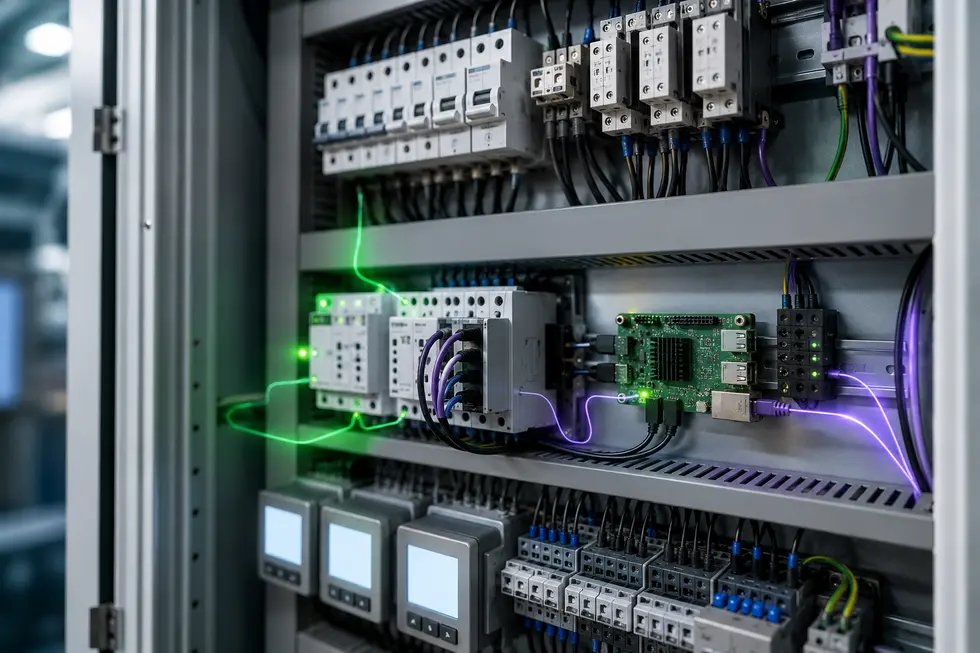
Equipment and data point lists, network access, existing programs and interfaces, and operating limits. We identify where measurement is sufficient and where control functions are needed.
Data connections, screens, alarms, permissions and control limits. We agree on local operation, communication failure handling and the test procedure.
Connection and configuration, checks of data points and units of measurement, and on-site tests. For active control, we also test manual override and fault scenarios.
Documentation, operator briefing, performance checks and fine-tuning. Support, operation and service availability levels are agreed separately.
Choosing the right solution
Integration is useful when data is accessible, responsibilities are clear and there is a meaningful operational goal.
The EMS and Node-RED integration described here does not replace a safety PLC, emergency stop or deterministic machine control. These require dedicated mechanical and automation engineering.
We cannot promise integration with any device without a documented interface and appropriate access. We first assess the manufacturer's options or the need for separate metering.
If reliable measurements, a consumption profile or controllable loads are missing, we start by collecting data. A generic savings percentage cannot replace a site assessment.
Related solutions
Frequently asked questions
We can also build on existing systems. We assess the device types, communication interfaces and available access, then choose a suitable integration or separate metering solution.
Yes. Measurement, visualization and reporting automation can be a standalone step. Active control requires additional access, operating rules and commissioning tests.
Node-RED is one of the tools we use for data connections and agreed local process logic. The system design defines the roles of the PLC, BMS and EMS; each device's own protective functions remain necessary.
The Smart EMS license, hardware, integration, commissioning and support are separate items. The required work can be defined after the equipment and data points have been assessed. Compare the plans in detail →
Let's discuss your project
Useful starting points include equipment types, a description of existing metering or monitoring, and the problem you want to solve.
Scepi Consulting · Industrial energy automation
We connect your site's meters, PLCs and building management systems. We make operations visible, automate data collection and design the necessary control functions within your site's operating limits.
Site survey · system integration · commissioning · support
Start with the operational need
Industrial IoT automation turns information from separate systems into useful operational data and processes you can follow.
Collect data from main meters, submeters, groups of machines and shifts. Industrial energy monitoring brings time series, dashboards and alerts together.
Submetering in manufacturing plants →Connect PLC data, building services, solar generation, energy storage and operational reports. Replace manual readings and repetitive data copying.
Which systems can we connect? →Industrial load control for equipment that can actually be controlled: priorities, time windows and power limits, with the process requirements taken into account.
Explore load control integration →PLC / BMS / EMS integration
The specific device, protocol, firmware and available access determine what can be read or controlled. We check these during the site survey.
Read machine states, counters and events; display and store the data. Changes to the control program are a separately agreed task.
Data point list · events · reportsConnect temperatures, states, operating modes and permitted setpoints to energy monitoring. We define the role of local control and manual operation.
Building services · comfort · operating hoursBring consumption, power, generation and available storage data together. Data access and permission to issue control commands are assessed separately.
Modbus TCP/RTU · manufacturer interfaceLocal data processing, data exchange between systems and agreed process logic. MQTT and REST API connections based on documented access.
Node-RED · MQTT · REST APIIndustrial energy optimization starts with measurement. We introduce active control with defined limits, manual override and tested fault handling. Savings can be assessed using the site's actual data.
Examples of our work
Three practical examples, from production data collection to equipment monitoring. Clients are presented by industry, with the completion status of each scope stated separately.
Food industry · completed work packages
Based on completed development tasks. This example covers data integration, not replacement of the entire production line control system.
Automotive site · system in operation
Based on implementation work and subsequent operational support.
Industrial site · technical implementation complete
Status as of October 1, 2026: technical implementation is complete; the handover process is still being finalized.
From site survey to support
We define the implementation scope, deliverables and acceptance criteria for each project.
Equipment and data point lists, network access, existing programs and interfaces, and operating limits. We identify where measurement is sufficient and where control functions are needed.
Data connections, screens, alarms, permissions and control limits. We agree on local operation, communication failure handling and the test procedure.
Connection and configuration, checks of data points and units of measurement, and on-site tests. For active control, we also test manual override and fault scenarios.
Documentation, operator briefing, performance checks and fine-tuning. Support, operation and service availability levels are agreed separately.
Choosing the right solution
Integration is useful when data is accessible, responsibilities are clear and there is a meaningful operational goal.
The EMS and Node-RED integration described here does not replace a safety PLC, emergency stop or deterministic machine control. These require dedicated mechanical and automation engineering.
We cannot promise integration with any device without a documented interface and appropriate access. We first assess the manufacturer's options or the need for separate metering.
If reliable measurements, a consumption profile or controllable loads are missing, we start by collecting data. A generic savings percentage cannot replace a site assessment.
Related solutions
Frequently asked questions
We can also build on existing systems. We assess the device types, communication interfaces and available access, then choose a suitable integration or separate metering solution.
Yes. Measurement, visualization and reporting automation can be a standalone step. Active control requires additional access, operating rules and commissioning tests.
Node-RED is one of the tools we use for data connections and agreed local process logic. The system design defines the roles of the PLC, BMS and EMS; each device's own protective functions remain necessary.
The Smart EMS license, hardware, integration, commissioning and support are separate items. The required work can be defined after the equipment and data points have been assessed. Compare the plans in detail →
Let's discuss your project
Useful starting points include equipment types, a description of existing metering or monitoring, and the problem you want to solve.